- The weather outside is frightful… Jan 19
- Green getaways Jan 17
- Eating well all winter… Jan 15
- Warm on the inside Dec 09
- Give the Gift of Green Gadgets Nov 14
- See all posts
Baby bedding
See all tips toGreenYour Baby bedding
Choose a natural crib mattress
Add
No matter what color you painted the nursery, a green crib mattress is the perfect complement to your FSC-certified crib and organic cotton crib sheets. After you've given baby a bath and bottle, and finally tucked the little one in for the night with teddy, take a break from diapers and laundry, and read on to discover why an eco-friendly crib mattress is the healthy choice for baby and the environment.
Find it! Natural crib mattresses
Eco-friendly options to seek out: Certified Organic wool or cotton and natural rubber. But be sure to ask questions of the manufacturer. Just because a crib mattress is labeled organic does not mean it has not been treated with chemicals. Verify that the mattress has not been treated with fire-retardant chemicals, and does not contain formaldehyde, synthetic or chemical foam, or chemical odor-reducer. If you can, find out what glues and adhesives are used as well.
Ecobaby Organics Crib Mattresses
Available in natural rubber-filled and innerspring styles, these crib mattresses are made with organic cotton and Pure Grow Wool. All mattresses meet CPSC guidelines and are chemical-free, containing no polybrominated diphenyl ether (PBDE).EcoPlanet Organic Crib Mattresses
Made with organic cotton, Pure Grow Wool, and natural latex, these mattresses are available in a variety of styles and prices, both innerspring and non-innerspring. They are made in the USA and contain no chemical fire retardants.Essere Organics Crib Mattresses
All chemical-free, Essere Organics carries innerspring and natural rubber crib mattresses, both layered with quilted organic cotton and wool. The innerspring coils are not treated with chemicals or oils. The mattresses are made in Canada and carry a 10-year warranty.Kushtush Organic Crib Mattress
Organic crib mattresses, available in innerspring or natural rubber, feature a wool layer quilted to organic cotton that meets all federal and state flammability guidelines without the use of chemicals. Also meets the CPSC's guidelines for firmness.Lifekind Organic Crib Mattress and Pads
Lifekind mattresses, available in both innerspring and natural rubber models, are made with organic cotton fabric and padding and Naturally Safer™ wool for chemical-free flammability protection. Mattress pads are organic flannel and wool.Naturepedic Organic Baby Crib and Children's Mattresses
Featuring a complete line of organic cotton innerspring crib mattresses, as well as mattresses and pads for portacribs, bassinets, and cradles, all products are free of Polyvinyl chloride (PVC) and polyurethane foam, and do not contain PBDEs or brominated or chlorinated fire retardants.Savvy Rest Natural Latex Organic Crib Mattress
The Savvy Rest crib mattress is built with 5 inches of all-natural latex, and wrapped in organic wool fiber quilted to organic cotton. The mattress is free of chemicals and can be ordered in custom sizes.
Before you buy
- Conventional mattresses are often treated with chemical fire retardants to pass federal flammability standards. Due to the strict fire retardant standards set by the Consumer Product Safety Commission (CPSC), you may be required to provide a note from your doctor saying you have chemical sensitivities to order a completely chemical-free mattress.
- Don't expect bargain basement prices. Eco-friendly mattresses typically cost what you would pay for a mid- to high-end standard mattress.
- If you're in the market to replace an old mattress, just remember, the fewer crib mattresses you use, the less resources needed to make new ones. So taking good care of your mattress and recycling it when its purpose has been fulfilled are two easy ways to green your crib.
Choosing a natural crib mattress helps you go green because...
- It reduces demand for standard crib mattresses that use petrochemical-based, nonrenewable resources.
- You support the production of organic cotton, natural latex, and organic wool, which do not use synthetic pesticides or synthetic hormones.
- Organic farming combats global warming through carbon sequestration.
Conventional mattresses contain man-made materials derived from petrochemicals and from natural gas, which are nonrenewable resources. Most mattresses are sprayed with toxic fungicides, pesticides, and flame retardants, as well as water- and stain- repellants. If they contain recycled steel springs, there may also be heavy metals present and other contaminants from the steel-recycling process.[1]
A number of crib mattresses contain cotton. When conventional cotton is grown, large amounts of toxic synthetic chemicals are used, which includes pesticides, dyes, fertilizers, and fixers.[2] Cotton farming uses only about 3 percent of the farmland around the world, but it consumes 25 percent of all chemical pesticides and fertilizers.[3] Billions of pounds of nitrogen synthetic fertilizers are used on cotton crops leading to runoff that creates "dead zones" in waterways. Chemicals in dyes and fixers that are not absorbed by cotton due to its natural resistance to dyes also run off into waterways and soil.[2]
Green crib mattress materials
Eco-friendly crib mattresses are made of varying combinations of organic cotton, organic wool, and natural latex. Some have innersprings, some contain latex instead of innersprings, and others combine innersprings with latex. Here's the lowdown on these materials:
Natural latex
Natural rubber is harvested by tapping the milk (sap) of Hevea brasiliensis (the common rubber tree), which grow in Indonesia and Malaysia.[4] The latex foam is made by whipping up the rubber tree sap. The sap can be collected for up to half of the year and the tree heals within an hour each time, making natural latex a genuinely sustainable resource.[5] In a mattress, natural latex is body-conforming and feels denser than a mattress with innersprings.[6]
Organic cotton
Organic cotton is grown and processed without insecticides, herbicides, fungicides, artificial fertilizers, or dioxin-producing bleach,[7] with control of crop pests, weeds, and diseases achieved mainly through physical, mechanical, and biological controls.[8]
Organic farming may also be key in fighting global climate change. During a 23-season study of conventional versus organic farming methods, the Rodale Institute discovered that organic farming combats global warming through carbon sequestration. In agricultural applications, the more organic matter that is retained in the soil, the more carbon is sequestered. While conventional farming depletes organic matter through the use of chemical fertilizers, organic farming uses animal manure and cover crops, which actually build soil organic matter.
Organic farming further reduces atmospheric carbon dioxide (CO2) by using 37 percent fewer fossil fuels than conventional farming.[9] The Rodale Institute estimates that if all 160 million acres of corn and soybean farmland in the US were switched to organic farming methods, it would be equivalent to removing 58.7 million cars from the road, and would satisfy 73 percent of the proposed US Kyoto targets for CO2 reduction.[10]
Organic wool
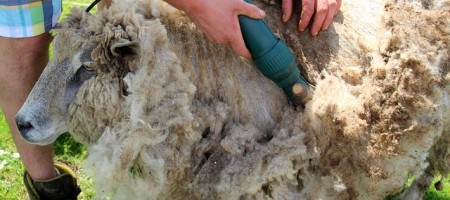
Wool is a sustainable resource because the wool is shorn each year and the sheep live on. Unlike conventional wool production, which involves the use of pesticides on pastures and chemicals in the sheep's feed, organic wool is produced without using hormones or pesticides in the animal or its food.
Pure wool is naturally fire resistant so fire retardant chemicals are not required on wool mattresses.[11] Wool's natural fibers are breathable and regulate moisture, helping to keep you warm when it is cold and cool when it is warm.[12] This moisture-wicking quality also may make wool mattresses less susceptible to dust mites, which like moist places.[11]
Controversies
Even mattresses made from organic and natural materials may be treated with chemical flame retardants or stain-resistant chemicals. On July 1, 2007, the CPSC passed a new flammability standard for mattresses to reduce the severity of mattress fires ignited by open flame.[13] There is much debate about the human health impacts of the chemicals required to meet the standard. One group, The People For Clean Beds, claims that the standard is only attainable by using heavy amounts of chemicals, and that these chemicals are absorbed into the body and may cause health problems. For example, according to their website, the CPSC's January 2006 Risk Assessment shows that 5-year-old children will absorb 0.5 mg of antimony every night—63 times the levels deemed safe by the US Environmental Protection Agency (EPA)—when sleeping on a chemically treated mattress. Antimony is an acute toxin that has been linked to cancer.[14]
But the Executive Summary of the CPSC assessment claims that, when five chemical flame retardants were tested for exposure and health effects in humans, they were "not expected to pose appreciable risk of health effects to consumers who sleep on treated mattresses."[15] One alternative to get around the whole controversy is to purchase organic mattresses wrapped in organic wool, which is naturally fire-retardant, and does not require chemicals to meet the CPSC's flammability-resistance standards.[16]
Related health issues
The rapidity with which babies grow can make any parent weepy, but it also makes those small bodies more vulnerable to environmental pollutants than older children or adults.[17] Newborn babies generally sleep 16 to 20 hours per day, and 6 to 12 month olds generally sleep about 14 hours per day.[18] Throughout that time, babies are being exposed to the chemical contents of mattresses and bedding, inhaling and absorbing them through the skin.[19] Chemical fabric treatments, pesticides, artificial colors and dyes, and toxic flame retardants may have detrimental health effects, from headaches to serious allergic reactions to respiratory problems to skin irritations.[20] Synthetic materials have poor air circulation and trap moisture, an ideal environment for dust mites and microbial growth.
Polybrominated diphenyl ethers (PBDEs) may be used as a flame retardant on mattresses, and can cause immune suppression, endocrine disruption, cancer, behavioral problems, and impaired brain development.[20] American women have among the highest levels of PBDEs in their breast milk: 40 to 60 percent higher than those of women in Sweden, where PBDEs are banned. Body concentrations of PBDEs are approaching levels linked to the serious health effects revealed in the animal studies in about 5 percent of the US population.[16]
Glossary
- antimony: A metalloid chemical element (having properties of both a metal and a nonmetal). Antimony and several of its derivative compounds can be toxic (causing headache, dizziness, or depression) or even fatal, depending on dose.
- carbon sequestration: The process by which carbon is captured (in the form of carbon dioxide, a greenhouse gas) from the atmosphere and incorporated into soil, ocean, and plant matter.
- polybrominated diphenyl ether (PBDE): A fire-retardant linked to brain and reproductive system disorders.
External links
- The Center for Children's Health and the Environment
- The Green Guide - Is My Baby's Mattress Safe?
- Low Impact Living - Eco-Smart Nursery for Baby
Footnotes
- Lifekind - Why an Organic Mattress? Compare the purity and environmental impact of an organic mattress to a mainstream, or “chemical,” mattress
- The Green Guide - Mattresses and Box Springs
- Sustainable Cotton - Organic Cotton: Production and Marketing Trends in the U.S. and Globally: Third paragraph
- Abundant Earth - Natural Organic Cotton Mattress & Box Spring
- The Natural Sleep Store - Frequently Asked Questions: Why buy a natural and organic mattress?
- EcoChoices - EcoBedroom: All Natural Mattresses
- Organic.org - Introduction to Organic Fibers
- National Organic Program - Organic Handling and Production Standards
- Straus Communications - Organic Farming Sequesters Atmospheric Carbon and Nutrients in Soils: The Rodale Institute Farming Systems Trial® Findings
- The New Farm - Organic farming combats global warming … big time
- Green Home - About Mattresses and Futons
- The Natural Sleep Store - Frequently Asked Questions: Why buy a natural and organic mattress?
- US Consumer Product Safety Commission - New Federal Mattress Standard Expected to Save Hundreds of Lives, Prevent Thousands of Injuries
- People For Clean Beds - A new law already effective in California
- US Consumer Product Safety Commission - Quantitative Assessment of Potential Health Effects From the Use of Fire Retardant (FR) Chemicals in Mattresses: Scroll to the bottom of the page for a link to the report.
- The Green Guide - Sleeping better! On chemical-free bedding
- Associated Content - Eco-friendly Nursery: How to Go Green
- Kids Health - All About Sleep
- People for Clean Beds.org - US Consumer Products Safety commission open public comment period on new law, Closes March 14, 2005
- The Green Guide - What's In a Mattress?


Latest Comments Across the Site