- The weather outside is frightful… Jan 19
- Green getaways Jan 17
- Eating well all winter… Jan 15
- Warm on the inside Dec 09
- Give the Gift of Green Gadgets Nov 14
- See all posts
Bedding
See all tips toGreenYour Bedding
Choose bedding made from organic fibers
Add
Mainstream bedding (the sheets, pillowcases, shams, bedskirts, blankets, and comforters we snuggle into at night) is often made of cotton or synthetic materials which take a toll on the earth. The farming and processing of conventional cotton puts lots of chemical pesticides, fertilizers, fixers, and dyes into the environment.
Find it! Bedding made with organic fibers
Bedding made from Certified Organic cotton and wool fibers largely eliminates the impacts of conventional bedding and may provide more restful shuteye. Also seek out products displaying other certification logos such as "Global Organic Textile Standard," Oko-Tex, and Skal. And if you're in the market for colored bedding, look for cotton that has been “color-grown,” which means the color is inherent in the fiber. These cotton plants are cultivated in native white, tan, green yellow, red, and brown colors.
Cuddledown Natural Cotton Fleece Blanket
Though not completely organic, these 100 percent cotton flannel blankets made in Germany are Oeko-Tex certifited, which means that their manufacture did not create air, water, or noise pollution; and that the product is free of toxins or irritants. Available in 7 colors and 5 sizes.EcoChoices EcoBedroom Organic Sheets & Pillowcases
Sheets and pillowcases made from handpicked certified organically grown cotton in Flannel, Percale, Damask Check, Damask Stripe, and Sateen. The sheets are not dyed. Flannel is available in ivory. The others are available in ivory—the natural ecru color of the cotton—and white, which is achieved by bleaching with hydrogen peroxide.EcoChoices Wool Comforter
The All-Season comforter is filled with Pure Grow wool, which is cleaned without bleaches, formaldehydes, dyes, or animal cruelty. The comforter is covered with unbleached natural organic cotton muslin.Egyptian Organic cotton blanket
100 percent Certified Organic Egyptian cotton blanket in a soft brushed cotton available in a dye-free natural off white color.Euphoria Organic Wool Comforter
This lightweight comforter handmade in Canada contains 100 percent organic, chemical-free wool from the Netherlands in a soft 290-thread count organic cotton (from Peru) quilted cover.Gaiam Deluxe Organic Flannel Sheets
Heavyweight, 100 percent organic cotton flannel sheets and pillowcases, yarn-dyed with low eco-impact dyes in solid colors of dried sage, natural, or bluebell. Mix-and-match retro stripe, cotton leaf, and snowflake patterns.Lifekind Organic Cotton Sheets with Hemstitch Lace
Woven of 250-thread-count Certified Organic cotton sateen, these sheets have organic lace Italian hemstitch on the flat sheet and pillowcases. Pillowcases also available. Choose ivory or white (whitened with hydrogen peroxide only). The organic cotton is grown in India by family cooperatives, and is certified organic by Skal.PureGrow wool blanket
This soft, 100 percent organic blanket is a natural weave of undyed PureGrow™ wool from Northern California.Rawganique Colorgrown Organic Cotton Blanket
Year-round weight, Certified Organic USA cotton blanket in chenille and waffle-weave styles. Choose from Ecru Natural or unbleached & undyed Colorgrown Mocha.Shepherd's Dream Wool Mattress Toppers
They've got several organic wool mattress toppers, all of which are pre-shrunk and washable on your machine's delicate/woolen cycle. Elastic at the corners holds it in place. The wool is minimally processed and free of chemical treatments.
Before you buy
If you suffer from allergies, you may want to encase your mattress with an "allergen barrier" to minimize allergic reactions to dust mites and mold spores. Also, air your bedding outside in the sun for several hours in the morning before making your bed. It's best to avoid fluffy comforters, and allergy sufferers and asthmatics should stay away from down and feathers. Pillows and comforters can be encased like mattresses. Even so, all bedding should be washed in hot water at least every two weeks.
Choosing bedding made with organic fibers helps you go green because...
- Bedding made from organic fibers like cotton and wool farmed using sustainable methods do not pose environmental harm to ecosystems, wildlife, or humans.
- Organic cotton farming combats global warming through carbon sequestration.
Bedding materials are largely made from cotton, which when grown conventionally has various environmental drawbacks. The textile manufacturing process also has environmental costs. For example, bedding textiles made from any fiber are put through multiple processing steps, including spinning, dyeing, weaving, scouring, and sizing. All involve flushing with water at one or more steps, which can result in wastewater contaminated with chemicals such as volatile organic compounds (VOCs) and bleach, which produces dioxin—a toxic substance regulated by the US Environmental Protection Agency.
Thankfully, untreated and organic fibers minimize some of these environmental costs because they are grown with sustainable agricultural processes. The natural bedding industry was initially embraced by individuals with chemical sensitivities but now enjoys growing support from those wishing to green their lifestyle.
Cotton
Though you may not be able to distinguish organic from conventional cotton in the store, there are some significant production differences that make the eco-friendly option readily apparent.
Pitfalls of conventional cotton
Conventional cotton farming uses only about 3 percent of the farmland around the world, but consumes 25 percent of all chemical pesticides and fertilizers.[1] It takes about 1.25 pounds of petroleum-based pesticides and fertilizers to produce one cotton queen-sized sheet.[2] Insects are quickly becoming resistant to recommended rates of pesticide application, and ever-increasing amounts are needed to be effective.
The various chemicals used to treat conventional cotton can harm beneficial insects and soil microorganisms, pollute groundwater and surface water, and adversely affect the health of humans and wildlife, including fish, birds, and livestock. Additionally, up to 70 percent of seeds used in conventional cotton farming in the United States are genetically modified.[3]
Billions of pounds of synthetic nitrogen fertilizers are also applied to cotton crops, leading to runoff that creates zones in waterways that are void of much life. Due to cotton's natural resistance to dyes, roughly half of the chemicals used as dyes or fixers end up as waste in rivers and soil. Chlorine bleaching to get cotton white before dyeing it also releases carcinogenic dioxins. The farming of conventional cotton is also water-intensive. Approximately 400 gallons of water are required to produce a single cotton undershirt.[4]
Organic cotton means healthy soil, water
As reported by the Organic Trade Association's 2004 Manufacturer Survey, sales of organic cotton fiber grew a total of 22.7 percent from 2002 to 2003. Sales peaked at around $85 million. In the 2007 Manufacturer Survey, it was estimated that the total sales of organic fiber and clothing in the US would grow an average of 40 percent each year from 2007 to 2010.[5]
Organic cotton is grown and processed without insecticides, herbicides, or fungicides with control of crop pests, weeds, and diseases achieved mainly through physical, mechanical, and biological controls. Organic cotton may be chemical-free, but its production still requires significant amounts of irrigated water (though on the plus side, water supplies aren't at risk of being contaminated).
Along with eschewing the use of chemicals and GMOs, organic cotton production nurtures soil health and fosters biologically diverse agriculture. From 2000 to 2001, an estimated 14 million pounds of organic cotton was harvested in 12 countries—about .03 percent of total global cotton production. The United States and Turkey were the top growers, producing 79 percent of the world's organic cotton supply (along with China and India) for the 2005-2006 harvest.[6] Domestically, Texas is the leading organic cotton producing state. In the US alone, 6,577 acres of organic cotton were planted in 2005.[7] Despite being a leading producer, there are only 12 organic-certified cotton producers in the country and domestic cotton farming—both conventional and organic—is in decline.[8]
Organic farming and global warming
Organic farming may also be key in fighting global climate change. A study of conventional versus organic farming methods by the Rodale Institute discovered that organic farming combats global warming through carbon sequestration.[9] In agricultural applications, the more organic matter that is retained in the soil, the more carbon is sequestered. While conventional farming depletes organic matter through the use of chemical fertilizers, organic farming uses animal manure and cover crops, which actually build soil organic matter.
Organic farming further reduces atmospheric carbon dioxide (CO2) by using 37 percent fewer fossil fuels than conventional farming.[10] The Rodale Institute estimates that if all 160 million acres of corn and soybean farmland in the US were switched to organic farming methods, it would be equivalent to removing 58.7 million cars from the road, and would satisfy 73 percent of the proposed US Kyoto targets for CO2 reduction.[11]
Wool
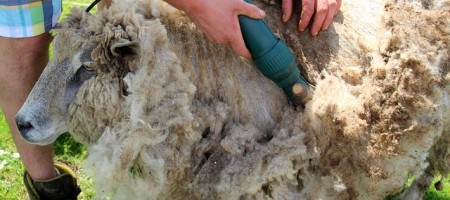
Wool is a sustainable resource because the sheep are not killed; they are merely shorn each year. In 2005, more than 19,000 pounds of organic wool were grown in six states and Ontario, Canada, with New Mexico as the leading producer at 15,300 pounds.[12] The total wool output in the United States in 2005 was around 39 million pounds.[13] Since pure wool is naturally fire resistant, fire retardant chemicals are not required.[14]
Organic wool production differs from conventional wool production in two important ways: the sheep cannot be dipped in insecticides to ward off pests like lice and ticks, and the grazing land provided for sheep cannot be overcrowded. This helps curb two environmental risks associated with livestock production—groundwater contamination and soil erosion due to overgrazing.
Certification
Bedding products manufactured in the US and labeled organic meet the US Department of Agriculture's National Organic Program rule for crop production, and if necessary, livestock production. To gain official organic certification in the US by a government-approved certifier, cotton must adhere to the same criteria established by the US Department of Agriculture for edible crops, since cotton seeds and oil are commonly used in food products: 95 percent of the ingredients must be grown in soil that has been free of toxic pesticides and fertilizers for a minimum of three years and the product cannot contain GMOs. However, it is possible for a product that is USDA "Certified Organic" cotton to contain 100-percent organic cotton but also contain harmful chemical dyes and finishes.
Wool must also meet strict criteria to gain official organic certification. It must be “grown” according to regulations for livestock production established by the US Department of Agriculture. These requirements include:
- No use of synthetic hormones or genetic modification.
- No synthetic pesticides can be used on the livestock themselves or on grazing pastures.
- The livestock’s feed and forage (from the last third of gestation) must be certified as organic.
- Livestock management must promote the health of the animals.
However, even when Certified Organic, wool and cotton are not guaranteed to be chemical-free. Other certifying organizations are working to address the fiber processing and manufacturing steps. The Organic Trade Association (OTA) has developed processing standards, entitled "The Organic Trade Association's American Organic Standards—Fiber: Post Harvest Handling, Processing, Record Keeping, & Labeling” that addresses all post-harvest processing, from storage of organic cotton or wool, to spinning, wet finishing, and labeling.
Instead of implementing these standards, the OTA has made them voluntary and recognizes a similar standard and certification program developed by the International Working Group on Global Organic Textile Standard (GOTS). This standard covers the production, processing, manufacturing, packaging, labeling, exportation, importation and distribution of all natural fibres. Bedding products that are produced in compliance with GOTS standards are labeled "Global Organic Textile Standard." At present, there are only four certifying agents (just one in North America) available and the certification does not appear to be widely implemented.
A separate European certification by the International Oeko-Tex Association is given to chemically treated textiles. Known as Oko-Tex Standard 100 or Confidence in Textiles, products that have received this certification have been tested to assess the environmental impact of various chemicals, such as carcinogenic dyes, formaldehyde, softeners, heavy metals, pentachlorophenol, and substances that are harmful to health but not yet regulated (pesticides, allergy-inducing dyestuffs or tin-organic compounds). The organization’s website includes the ability to do a brand name search for certification. Manufacturers that meet the standards are licensed to use the registered Oeko-Tex Standard 100 label on their products.
Note: The Skal organic certification, seen in European-produced bedding products, includes the processing of agricultural products as well as agricultural production. Therefore, natural bedding products bearing the Skal logo are made with chemical-free finishing, such as wheat starch as the sizing agent. Hydrogen peroxide is used to whiten cotton instead of chlorine bleach and low-impact dyes are used.
PureGrow Wool is another certification body just for wool PureGrow is produced by farmers who raise their sheep organically and humanely. A co-op started in Sonoma County, California, this organization requires sheep raised to produce wool with the PureGrow label to have absolutely no chemicals, pesticides or artificial materials in their environment including pastures and food. When sheep are given medications, they must be free of synthetics, and shearing takes place in a clean, safe environment that's healthy for the sheep. This certification has allowed many farmers to specialize in organic wool production, which in turn has preserved this shrinking industry in the US.
Related health issues
American adults spend an average of about seven hours a night sleeping, being exposed to the chemical contents of mattresses and bedding, inhaling and absorbing them through the skin.[15] Chemical fabric treatments, pesticides, artificial colors, dyes, and hazardous flame retardants may have all kinds of negative health effects, from headaches to serious allergic reactions. Synthetic materials have inferior air circulation and trap moisture, an ideal environment for dust mites and microbial growth. This is a problem for allergy sufferers.
Controversies
Many individuals and organizations, such as [http://www.savethesheep.com/animals.asp People for the Ethical Treatment of Animals (PETA)], take issue with how wool-producing sheep are treated—even those subject to a pesticide-free, environmentally sound production process. A particular act of sheep mutilation that has caught the attention of animal rights supporters is the “mulesing” of Australian Merino sheep. Merinos are bred to have wrinkly skin that, in turn, results in higher yields of wool. These characteristic wrinkles attract flies that lay eggs in the folds of skin, resulting in fatal maggot infestations. To prevent this, ranchers perform mulesing—the sheep are restrained without painkillers and chunks of flesh are removed from the area around the tail, resulting in smooth skin that discourages fly egg-laying.
Mutilation aside, another environmental danger of the wool industry is enteric fermentation—or livestock belching and flatulence—a major contributor to global climate change. In New Zealand, for example, 90 percent of the nation’s greenhouse gas emissions (methane, in particular) result from enteric fermentation, primarily from sheep.[16]
Glossary
- carbon sequestration: The process by which carbon is captured (in the form of carbon dioxide, a greenhouse gas) from the atmosphere and incorporated into soil, ocean, and plant matter.
- genetically modified organism: GMOs result from merging the genetic makeup of two organisms to create a desired byproduct that could otherwise not be found in nature. Using genetically modified seed is a common practice in conventional farming. Studies have shown that GMOs pose significant environmental risks and cause some insects which feed on GM crops to become resistant to pesticides.
- methane: A greenhouse gas released into the atmosphere from both natural and man-made sources, including landfills, agricultural activities, wastewater treatment, and coal mining. Once introduced into the atmosphere, methane can exist for 9 to 15 years. It’s more effective in trapping heat in the atmosphere (global warming) than fellow greenhouse gas, carbon dioxide.
- volatile organic compounds (VOCs): Organic solvents that easily evaporate into the air. VOCs are emitted by thousands of products including paints, cleaning supplies, pesticides, building materials, and furnishings and they may cause immediate and long-term health problems.
External links
- Care2 - How Safe is Your Bed? The Healthy Bed Quiz
- CEPA Environmental Registry - Frequently Asked Questions: Polybrominated Diphenyl Ethers (PBDEs)
- Children's Health Environmental Coalition (CHEC) - Rest Easy on a Safe Bed
- Coop America Business Network - The Organic Bedding Industry Gains National Exposure On CBS’s The Early Show: Trend Report
- Grist - Advice on natural fabrics vs. polyester
- Healthy Children Project - Our Children's Health, Up in Flames!
- National Organic Program - Organic Handling and Production Standards
- Organic.org - Introduction to Organic Fibers
- Organic Trade Association - Organic Wool Fact Sheet
- Organic Trade Association - Organic Cotton Facts
- Pesticide Action Network North America - Problems with conventional cotton production
- ProQuest CSA - Genetically Modified Foods: Harmful or Helpful?
- National Sleep Foundation - Sleep Facts And Stats
- US Environmental Protection Agency - Formaldehyde
Footnotes
- Sustainable Cotton - Production and marketing trends in the US and globally
- The Green Guide - Sheets
- Organic Exchange - Organic Cotton
- US Geological Survey - Water Facts
- Organic Trade Association - 2007 Manufacturer Survey: Executive Summary
- Organic Cotton Fiber Report - Executive Summary, Spring 2006
- Organic Trade Association - Organic Cotton Facts
- Grist - A Loom with a View
- Food and Society Policy Fellows - Organic Farming Fights Global Warming
- Straus Communications - Organic Farming Sequesters Atmospheric Carbon and Nutrients in Soils: The Rodale Institute Farming Systems Trial® Findings
- The New Farm - Organic farming combats global warming … big time
- Organic Trade Association - Organic Wool Fact Sheet
- Agricultural Marketing Resource Center - Wool Profile
- Green Home - About Mattresses and Futons
- People for Clean Beds.org - US Consumer Products Safety commission open public comment period on new law, Closes March 14, 2005
- Save the Sheep! - The Environment


Latest Comments Across the Site